
The Speedmaster is a watch defined by continuity. Few designs in watchmaking history have evolved so slowly, or so deliberately, over such a long production run. That consistency is precisely what makes the Speedmaster so foundational to collecting, and why it remains one of my easiest recommendations for anyone beginning to explore vintage watches (or watches, period).
It is also why deviations from the norm matter so much. Racing dials, radial dials, and transitional references are all prized because they interrupt the otherwise stable visual language. Among those departures, the metallic blue “soleil” dial occupies a category of its own, as it remains shrouded in mystery after all these years. It is not documented in period catalogs or tied to a specific reference, and despite decades of study, its origin is unknown.
Rather than attempting to solve the mystery outright, this article focuses on what can be observed with confidence: just how rare these dials are, the competing theories surrounding their appearance, and how collectors have come to evaluate them today.
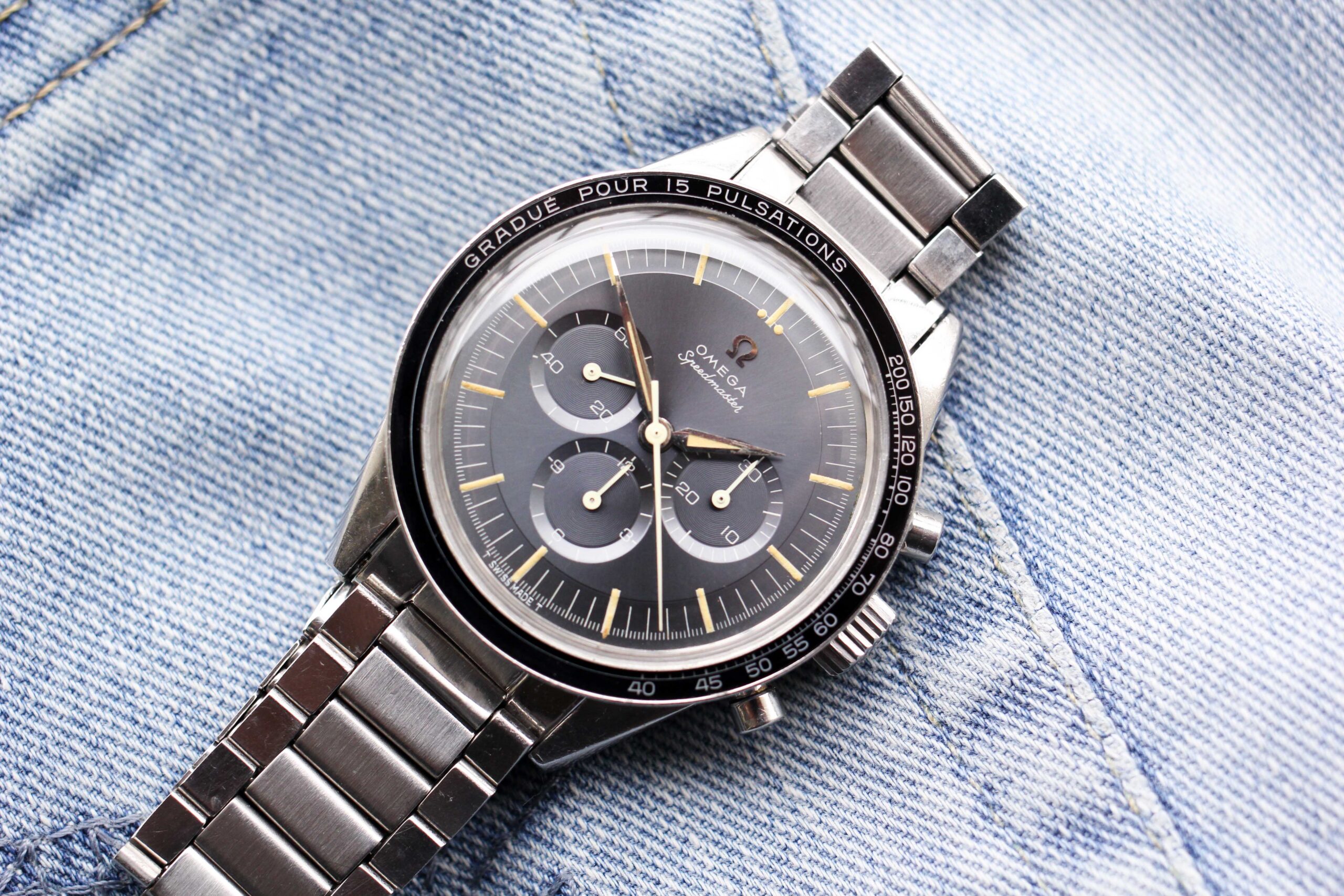
Soleil Dials – Like Needles in a Haystack
Any discussion of soleil dials has to begin with scarcity.
“There just aren’t enough of these around to build a real data set,” notes Sacha Davidoff, who, with his brother Roy Davidoff, has handled more Speedmasters than almost any dealer alive. “We’ve sold maybe two or three true soleil dials, plus another two grey examples that weren’t soleil.”
That number alone is telling. Even accounting for watches held in long term collections, the total population is shockingly small. Most examples surface only once, and often with compromised condition due to the fragile galvanic process used to achieve the metallic finish. Oxidation, discoloration, lume loss, and careless service work commonly cause issues with these rare dials. Finding a clean example is, as Sacha put it, “close to impossible.”

Compounding the mystery that these dials present, soleils appear across multiple references and dial layouts. Long hour indices and short indices are both documented. Some examples carry “pre-Professional” text, others the later Professional designation. Most importantly, there is almost no rhyme or reason to the underlying references that house the dials other than the fact that they are exclusively caliber 321 models.
Finally, Omega has no record of these dials, nor were they ever offered publicly as an option (i.e. in price lists), but their construction, fonts, lume application, and finishing are undeniably authentic to Omega. The question then is not whether they are authentic, but how and when they were used – which leads us to the two prevailing theories.
Theory #1: Service Additions
The most conservative explanation is also the most widely accepted: Soleil dials were fitted during servicing.
Omega’s service practices during the 1960s and early 1970s were far more flexible than modern collectors might expect. Dial swaps were routine, particularly when original dials were damaged or degraded. From this perspective, soleil dials could represent a couple of distinctive, small batches of replacement dials produced for the caliber 321 era and installed as needed.
One needs to look no further than my own watch as evidence of the service theory, as the reference 2998-5 pre-dates the tritium era entirely and used radium dials. Put simply, the tritium on my soleil dial wasn’t even being produced by Singer (Omega’s dial manufacturer) at the time my watch rolled off the production line.
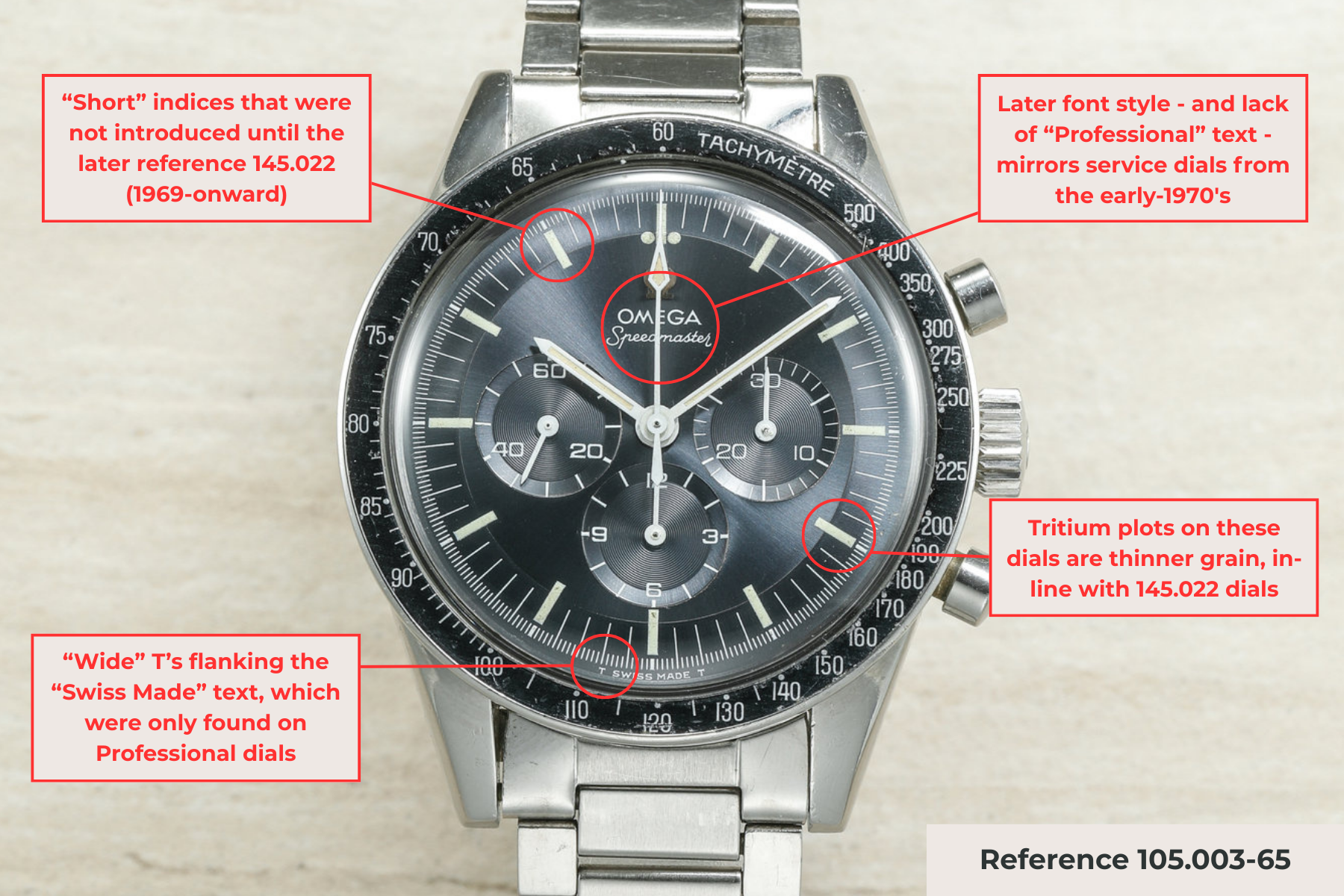
This theory is further strengthened by inconsistencies between identical references that have surfaced with completely different soleil executions. Take the two 105.003-65 examples below, for instance, which feature markedly different indices, lume plots, and text spacing. The first of which features a dial that is the same as my own and was likely produced in the mid-1960’s (we’ll refer to this as a “Mk1” soleil dial from now on).

The second, which is the most recent soleil dial to be sold publicly (via the Davidoff Brothers), is the same reference as above but sports a significantly different dial (a “Mk2” for article purposes). In fact, the very same Mk2 dial also has appeared in an early “Professional” model as well (see second picture below).
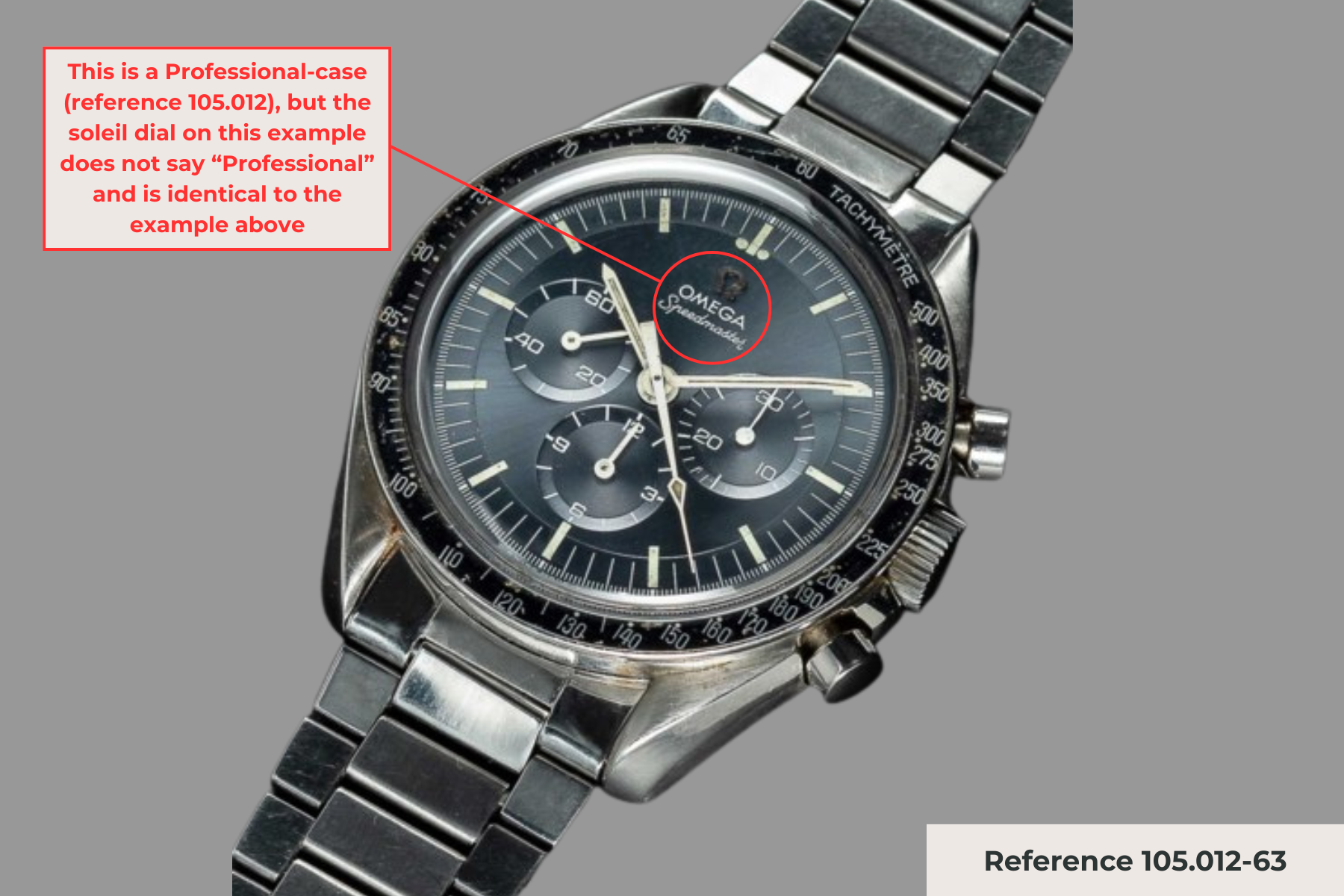
Confused yet? It only gets more confusing when you factor in Theory #2.
Theory #2: An Upsell at the end of the 321 Era
The second theory is more speculative, but also potentially more compelling. Sacha and others believe that at least some soleil dials were introduced deliberately to help retailers sell remaining stocks of caliber 321 Speedmasters around 1969. By that point, Omega was preparing to transition fully to the caliber 861, and unsold 321 inventory represented a commercial problem.
“The physical attributes of these dials are important,” Sacha explained. “The font of the Omega Speedmaster logo, the shorter tritium markers, and the finer grain of the lume all point to production in late-1969, just as the Speedmaster line was transitioning to the 861 caliber.”

That timing is significant, as Omega had already demonstrated a willingness to experiment off-catalog to stimulate demand, releasing racing dials and the so called “Ultraman” during the same period. The museum holds no record of soleil dials being cased at the factory, but that absence may be the point. These were not standard products. Also importantly, soleil dials have only been observed on caliber 321 watches and are not compatible with caliber 861 Speedmasters.
Theory #2 is echoed by another Speedmaster devotee, Matteo (better known as @themasterofspeed), who owns a 105.003-65 with a soleil dial that was purchased from the son of the original owner. While this may provide evidence in support of Theory #2, there is one wrinkle – the seller’s father had purchased the watch from a friend and was not the original owner of the watch, so it is impossible to confirm if the watch was purchased with a soleil dial or it was added after the fact.
An Examination of My Soleil
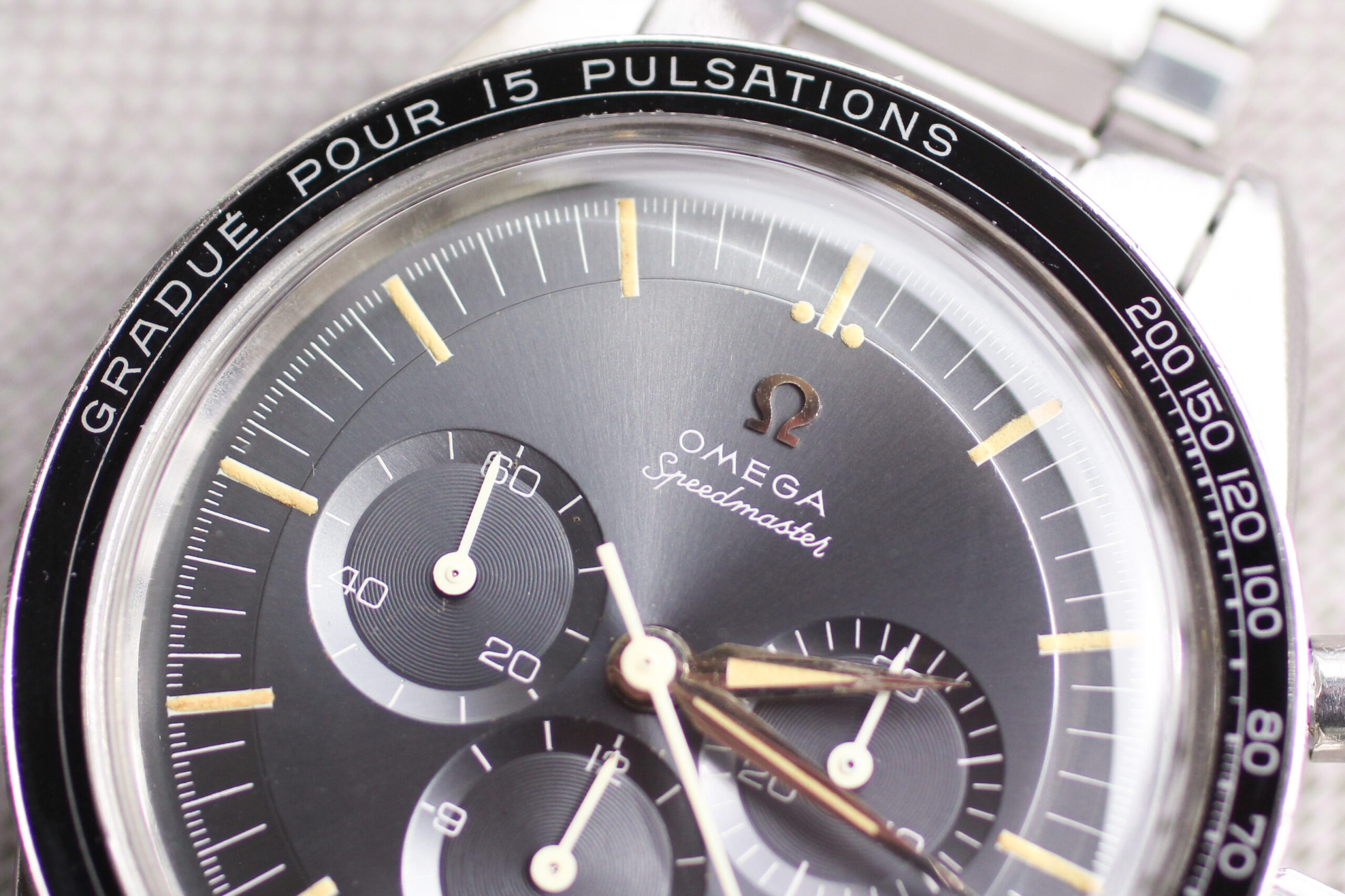
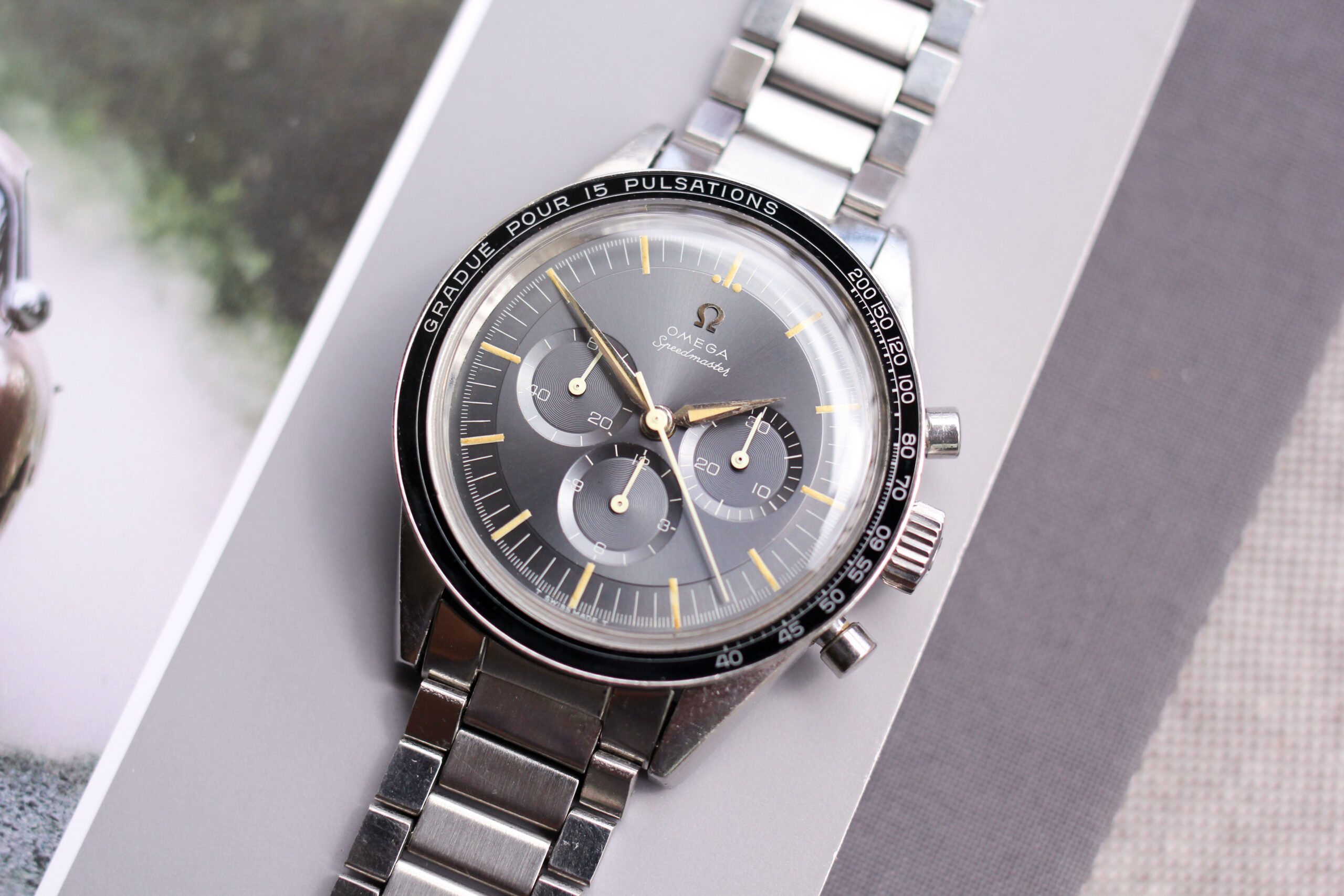
This example is, at least to my potentially biased eye, one of the best examples of a soleil dial to surface to-date. For the sharper students in class, you will recognize the dial is a “Mk1” with thinner font and long tritium indices. The underlying reference is 2998-5 – a reference that pre-dated the use of tritium and further confirms that this particular dial could not have been born on this watch.

The dial itself shows the deep blue/gray tone characteristic of the type, with a sunburst finish that remains clearly visible and largely free from the oxidation or damage that often affects these dials. The tritium plots have aged to a beautiful, creamy hue that pops against the metallic dial finishing.
Further enhancing this example is the presence of a well-preserved pulsations bezel. Seen far less frequently than the standard tachymeter (and rarely in this condition), it adds another layer of interest and visual appeal. Taken together, it is a cohesive and visually compelling example, which ultimately matters more to me in this case than ironclad provenance or an extract from Omega.
Market Trends and General Collectibility
“Even though these are among the rarest Speedmasters ever made, they do not have the widest following, which is likely due to the general lack of understanding about them,” Sacha noted. In fact, he likened the soleil market to the way Paul Newmans dials are collected within vintage Rolex circles. Condition matters more than paperwork, and provenance is a bonus rather than a prerequisite.
“If the dial makes sense and the condition is good, that’s enough for us,” he explained. “The rest is context.”
That approach explains why some examples struggle publicly. A poorly aged soleil dial, despite its rarity, can be visually unappealing. The galvanic finish does not always age gracefully, and when it goes wrong, it results in a watch that, put simply, is unattractive. An example of this was the watch below, offered by Phillips in 2018 (at perhaps the height of the Speedmaster market) with an estimate of 60,000-120,000 CHF.
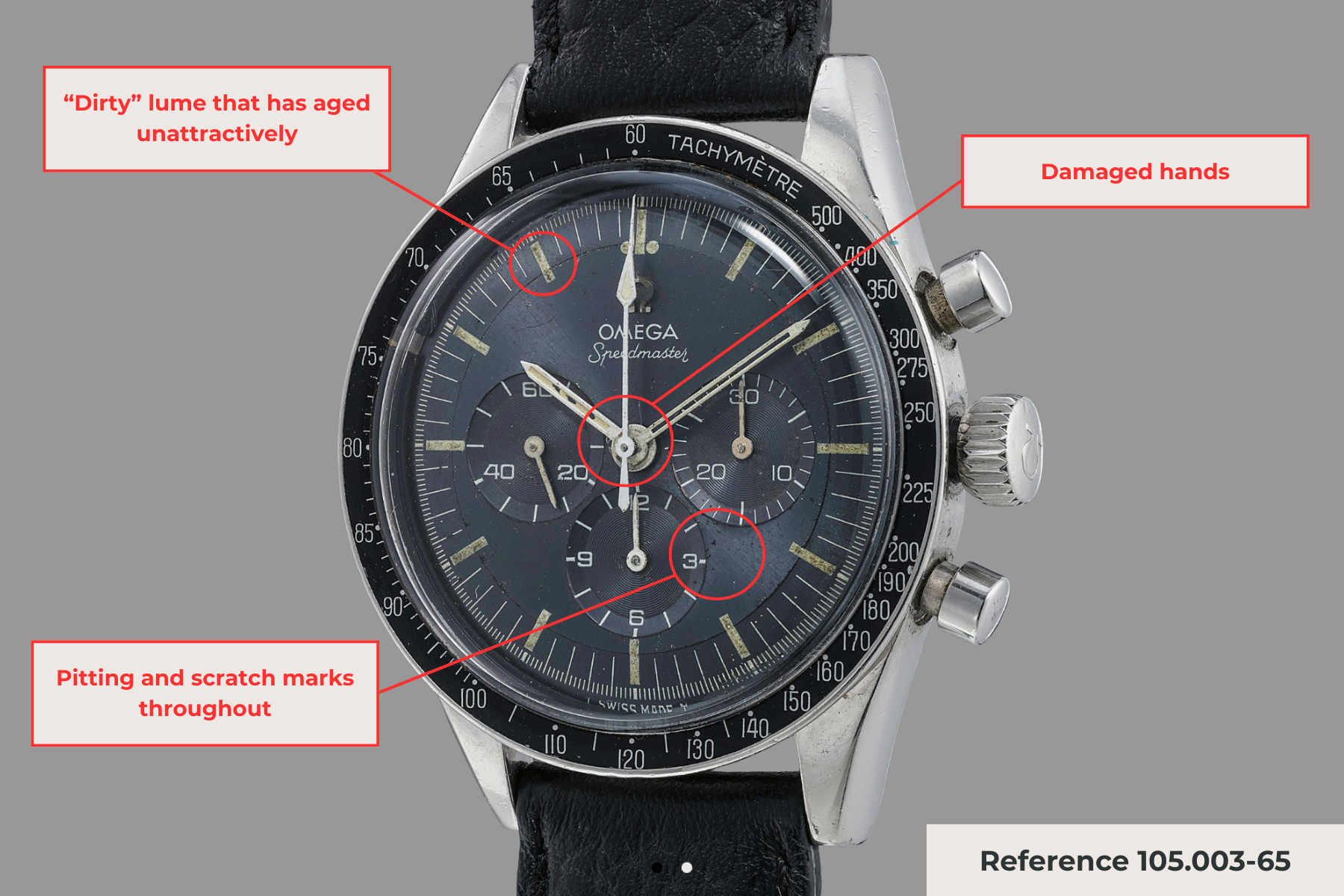
Unsurprisingly, the watch failed to find a buyer, which – at least to my eye – is quite easily explained by the condition of the example. The soleil dial was technically correct and matched other publicly observed soleils, but the overall attractiveness is considerably lower than a more well-preserved dial.
As Sacha alluded to above, the overall scarcity of soleil dials does not lend itself to a robust data set for market pricing purposes. Anecdotally, recent sales (as of early 2026) have hovered in the $40-50K range for good examples, which places these among the most expensive Speedmasters one can buy.
A Subtle Acknowledgement From Omega?
Interestingly, Omega’s 2024 release of the new First Omega In Space can be read as a near-direct re-issue of my watch discussed here, with the only meaningful tweak being a deeper hue to the metallic blue dial. While Omega has not positioned the watch as a historical reproduction of the soleil dials, the visual parallels are difficult to dismiss as coincidence.

However, in my view, the modern reissue is unlikely to meaningfully affect the vintage market. Soleil dials remain far too rare, too condition-sensitive, and too idiosyncratic to be influenced by a contemporary release. Instead, the new FOIS feels more like a tacit acknowledgment from Omega, effectively winking to a strange and unresolved chapter in the Speedmaster story that collectors have been piecing together for decades on their own terms without any help from the company.
Closing Thoughts
For all of the uncertainty surrounding their origins, there is remarkably little disagreement about the appeal of soleil dial Speedmasters. Even among collectors who remain skeptical of their backstory, the combination of a metallic blue sunburst finish and the familiar Speedmaster architecture is hard to ignore. Add in the extraordinarily small number of surviving examples, and it becomes clear why these dials consistently command attention whenever they surface.
The two prevailing theories surrounding their creation are often treated as competing explanations, though it may be more useful to view them as overlapping possibilities. It seems plausible – at least to me – that the earliest “Mk1” examples began life as experimental or service dials, fitted opportunistically rather than as part of any formal program.
The later short indices variants (“Mk2”), meanwhile, appear to align more closely with Omega’s broader efforts in the late 1960s to stimulate sales as the caliber 321 era drew to a close and the transition to the caliber 861 and reference 145.022 approached. Whether this was deliberate strategy or corporate improvisation remains an open question.
Regardless of how they were originally deployed, soleil dials occupy a singular place in the Speedmaster canon. Their appeal lies in the combination of beauty, scarcity, and an unresolved history that, against all odds, remains a curiosity for Speedmaster experts despite years of scholarship. In a collecting world that has left almost no stone unturned in the Speedmaster’s evolution, the soleil’s ambiguity may be the entire point of its appeal. Put simply, it’s a gorgeous and mysterious chapter in the iconic legacy of the Speedmaster, and one that I feel privileged to own.