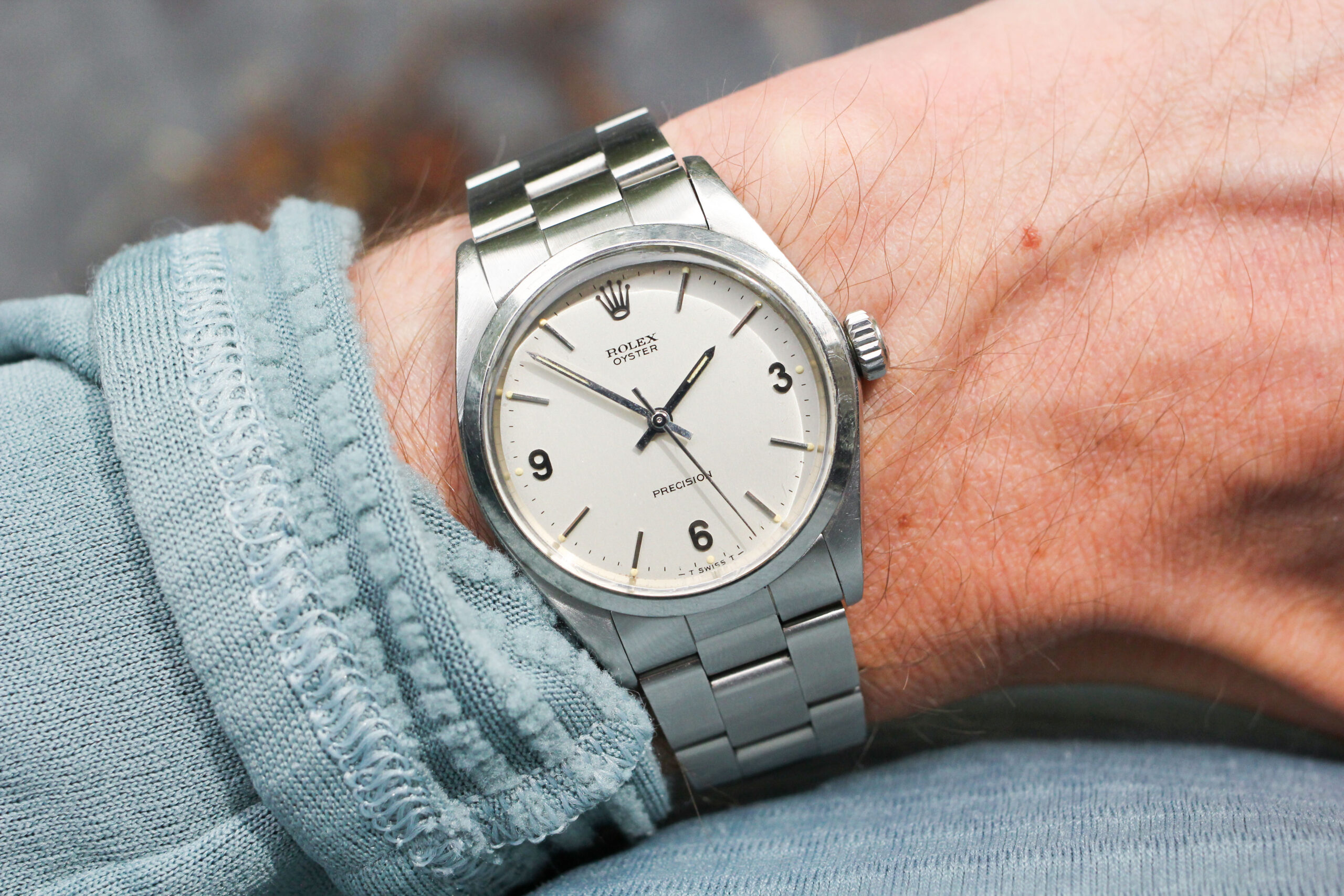
The world of vintage Rolex has become increasingly binary over the past couple decades: sports models that dominate collector attention, and everything else. The Daytona, GMT Master, Submariner, and Explorer are coveted by collectors and studied in painstaking detail. They’re the cool kids at the lunch table, covered in lore and built up by auctions and dealers alike.
The next table is full of the “other” high production vintage Rolex models. The Day-Date, Milgauss, and Datejust have pockets of interest within collecting circles and can command strong prices on their own, but for most collectors they do not inspire the same level of obsession as Rolex’s sport watches.
And then, tucked quietly in the corner of the cafeteria, is the Rolex “Oyster Precision.”

The “Precision” moniker doesn’t actually refer to a specific model from Rolex, but for the purposes of this article, I will focus on the reference 6426, which was the most commonly seen version in the 1960’s and 1970’s. The Oyster Precision was positioned as an entry-level Rolex, produced in large numbers and marketed as the most affordable watch in the brand’s catalog.
Most examples feature simple silver dials with “Rolex Oyster” above the hand stack and, in some cases, “Precision” on the lower half of the dial. Compared to contemporaries like the Datejust or Explorer, the watch was smaller and thinner, measuring 34mm in diameter and powered by the manually wound caliber 1225 – a relative rarity in a Rolex catalog that was increasingly dominated by automatic movements.

Prices for standard Oyster Precisions have remained remarkably stable for years, typically trading in the ~$2,000–4,000 range regardless of broader trends in the vintage Rolex market. That low barrier to entry, combined with reliability and ease of service, makes the Oyster Precision an ideal first step into vintage Rolex collecting. It is a low-risk watch that has aged gracefully and is easy to live with.
So why, at this point in my collecting arc, was I ecstatic to see a reference 6426 pop up in a small winter auction? Well, even my least observant readers will notice a stark difference between the “standard” 6426 dial and the watch that is the subject of this article.

Oyster Precision – Special Dials
For all its charm and sensibility, the Oyster Precision is a watch you will rarely see on the wrists of more seasoned collectors. And that makes sense – once you’ve owned Daytonas and GMTs, there is little in the standard Oyster Precision that generates the same excitement…with the potential exception of two outliers.
There are two models within the Oyster Precision line that transcend to a higher level of collectibility: i) the Commando, and ii) the watch that is the subject of this article, which I will henceforth dub the “Diplomat” (spread it like wildfire, people).
- The Commando: The Commando featured the same case and movement as the reference 6426 but was only available through military PXs and Abercrombie & Fitch (no, not the oiled up lifeguard version). It carried a unique reference number, 6429, stamped inside the caseback and was produced for just one to two years. Fewer than 25 examples are known today, and the model has become a darling of certain Rolex collecting circles, with prices now firmly in the mid-$20K range.
- The “Diplomat”: To my eye, this reference 6426 dial is a more refined iteration of the Commando that exchanges aggressive tritium lume and high contrast for a more subtle take on the Explorer motif. If the Commando was worn by soldiers trudging through the Vietnam War, this watch was more likely to be worn by the diplomat who did battle in a suit and tie. Too corny? Whatever, it’s too late to turn back now.

Tony Traina has already done an excellent job documenting the Commando on Rescapement, tracing its history and place within the collector landscape. But with so few Diplomats known to exist, the lesser-known of the two has largely escaped similar scrutiny. Until now!
What We Know About The Rolex Diplomat
I first became aware of this rare dial variation in 2020 when Wind Vintage posted one for sale, and since that time, I have tracked down seven additional examples (including my own). With less than ten of these dials circulating amongst collectors to-date, that places this humble Oyster Precision among the rarest vintage Rolex dial variants known today.
While no period advertisements or archival records shed light on the origins of the “Diplomat” dial, a few meaningful patterns emerged during my research. Most notably, the majority of known examples cluster into two distinct serial ranges. The earliest two serials are separated by just 14 numbers, while the next four examples all fall within the 2,640,XXX range (including two with sequential serials).

The picture becomes even more compelling when geographic origin is considered. Of the first six examples identified, five can be confidently traced back to the UK. The origin of the sixth, sold at Phillips’ November 2024 TOKI sale in Hong Kong, remains an open question. At minimum, this concentration suggests that the Diplomat may have been produced in small batches specifically for the UK market.
Additional circumstantial evidence supports this theory. The caseback of my own example bears a personal inscription with UK vernacular: “TO CHARLES ON YOUR 21ST BIRTHDAY, MUM & DAD.”

The remaining two known examples sit apart from the others, with serial numbers that do not correspond to either cluster (or each other). Whether these represent later production, special orders, or something else entirely remains unclear, though future discoveries may bring the picture into sharper focus.
Unpacking The Diplomat’s Design
From a design standpoint, the dial leans into the “Greatest Hits” from some of its sportier peers, with a dial color and finishing that is reminiscent of early “double Swiss” Daytona dials and the same classic “3-6-9 Explorer Dial” design that found its way into everything from Subs to Commandos in the 1950’s and 1960’s.

However, unlike Explorers, Commandos, and Submariners, this is one of the few “Explorer dials” that has applied numerals and baton markers. The result is a more dressed up version of the iconic Explorer design language, and while other Oyster Precision references had utilized “3-6-9” previously, none steered as closely to the Explorer aesthetic as this one.
Another comparison can be drawn to ultra rare “Albino” Explorers, most commonly seen in the reference 6610 and produced more than a decade earlier. When you start to compare the two, however, there are a few key differences: the Explorer relies far more heavily on lume, features a closed chapter ring, and uses a matte white dial rather than the Diplomat’s warm silver tone. To a non-collector, they are both light-dial Rolexes with 3-6-9 layouts. To a watch nerd, they are second cousins, not brothers.

On the wrist, the Diplomat wears, well, like a Rolex Oyster Precision. The manual wind movement allows for a svelte presence on the wrist, and while some may scoff at its smaller size than the Explorer, the watch’s larger lug-to-lug dimensions (42mm, as well as 19mm lug width) means it wears more substantially than its 34mm diameter would otherwise suggest.

List of Publicly Seen Examples
To track the market, I have compiled a list of all publicly known examples to date (including my own) and will do my best to keep it updated. If you are aware of an example not listed here, please reach out!

Market Update (January 2026)
Rarity alone does not automatically equate to eye watering valuations, but this particular Oyster Precision punches well above its weight. There is only one example that sold publicly (prior to mine), which was included in Phillips’ TOKI sale in November 2024 and sold for ~$18K all-in. This is also in-line with two private sales that have occurred in the past four years, so private market valuations are likely in the $14-17K range as of early 2026.
As mentioned earlier, Commandos currently trade for ~$25K in good condition, representing a ~40% premium over the Diplomat. While aesthetics will always be subjective, much of the Diplomat’s appeal lies in its eggshell-like dial and applied numerals, details that are much more distinctive within the world of 3-6-9 layouts. By comparison, the Commando’s differentiation rests less on design and more on its unique reference number and military-adjacent origin story, as its visual language largely mirrors that of the Explorer. This is not meant to diminish the Commando, but rather to underscore how the market puts a premium on its surrounding story.
Long-term, the 6426 Diplomat likely isn’t destined to command breathless auction headlines, but its combination of scarcity, charm, and perfectly executed design simplicity makes it worthy of patience and years-long hunting from vintage Rolex enthusiasts. I will periodically update this market overview as additional public data points become known.