
Every once in a while, a watch surfaces that doesn’t fit neatly into the accepted story, and in doing so, re-writes a chapter of the book. This Heuer Carrera 2447NST is exactly that: a unique transitional dial that shouldn’t exist, but does.
In the world of vintage Heuer collecting, few models capture the purity and intent of the brand’s golden era quite like the Carrera. Introduced in 1963, the Carrera defined Jack Heuer’s design philosophy, which emphasized purpose and legibility above all else. Compared to the Autavia, the Carrera’s lack of a bezel and smaller size creates a more restrained and “pure” take on a sports chronograph.
It’s not a stretch to say that the early, three register Carrera (reference 2447) is one of the true icons in vintage watches, yet even within this well-documented lineage, the present watch (below at right, next to a “normal” 2447NST on the left) invites more questions than answers.
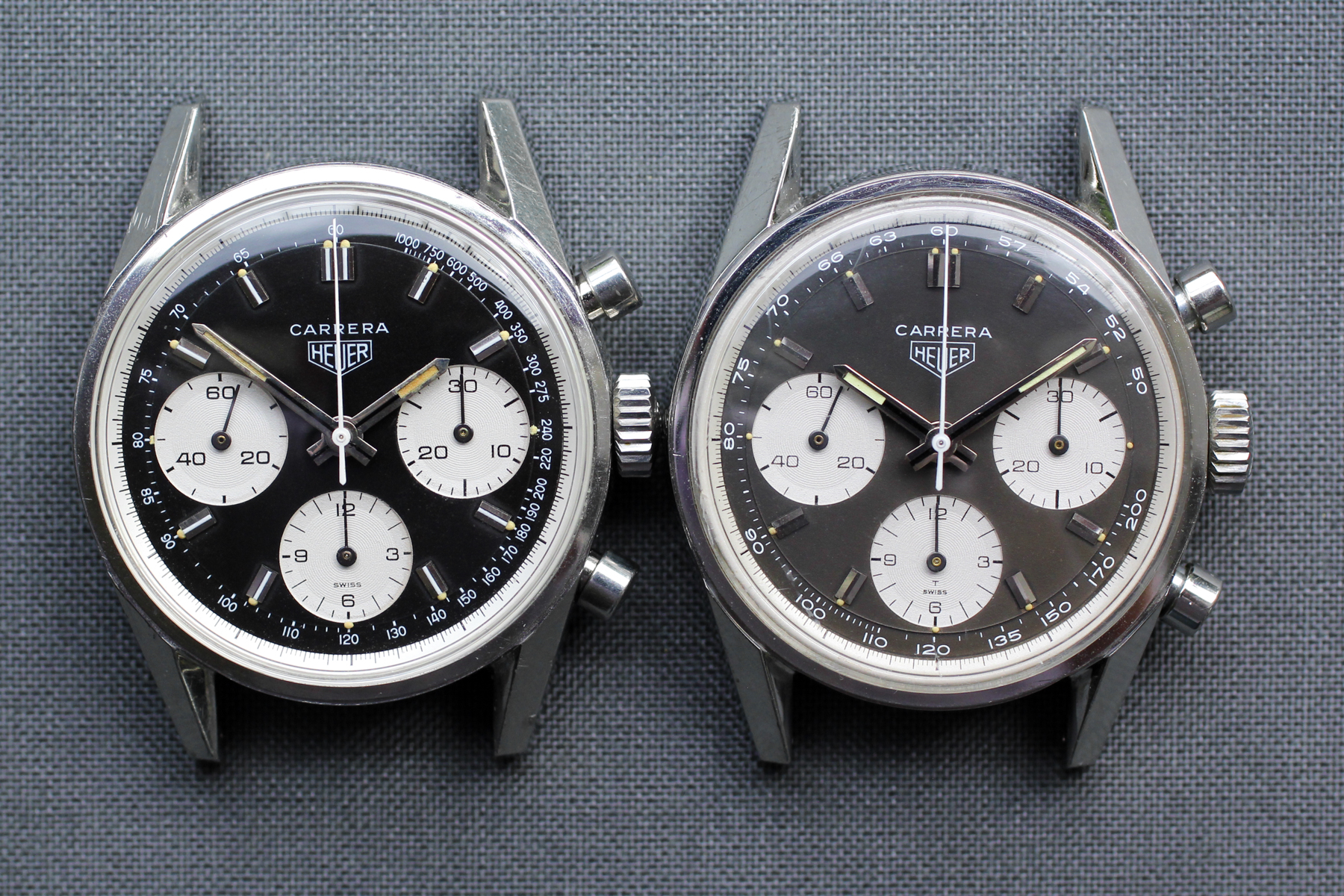
Evolution of the 2447 Tachymeter Dials
For those who do not know Carreras intimately, the reference 2447 was powered by the Valjoux 72 movement and produced through two distinct executions from 1963-1970. There is also a notable “break” in serial ranges between first and second executions, with the first execution tachymeter dials ranging from 53XXX-94XXX and second executions from 91XXX-105XXX. Astute readers will notice that there is slight overlap between observed examples ranging from 91XXX-94XXX…keep that in mind, as it will come back into play in a bit!
From a design standpoint, first execution tachymeter dials featured black or silver dials without contrasting subdials, thinner hands, solid metal hour markers, and a Base-200 scale running along the outside. Second execution models followed later with contrasting (“panda” and “inverse panda”) subdials, striping on the hour markers and handset for better legibility, and an updated Base-1000 tachymeter scale layout.

The architecture of tachymeter dials also notably shifted from the initial version, with the second execution adding a more defined “step” to the inner portion of the dial compared to the previously convex-shaped design (like an upside-down pie pan) on first execution dials.

All of the details above may seem small or trivial to some people, but to vintage obsessives, the small details are what add intrigue and lore to the most collectible references. Heuer, like its peers, was constantly iterating and perfecting its designs, and it wasn’t until years later that collectors began to draw lines between executions and obsess over the minutia.
Now I know a portion of my readers’ eyes are glazing over, so if this deep dive is boring you, the main thing you need to take away from this section is that the two dial executions are visually distinct and pretty cleanly divided by serial number ranges. Except, as this watch proves…they aren’t entirely.
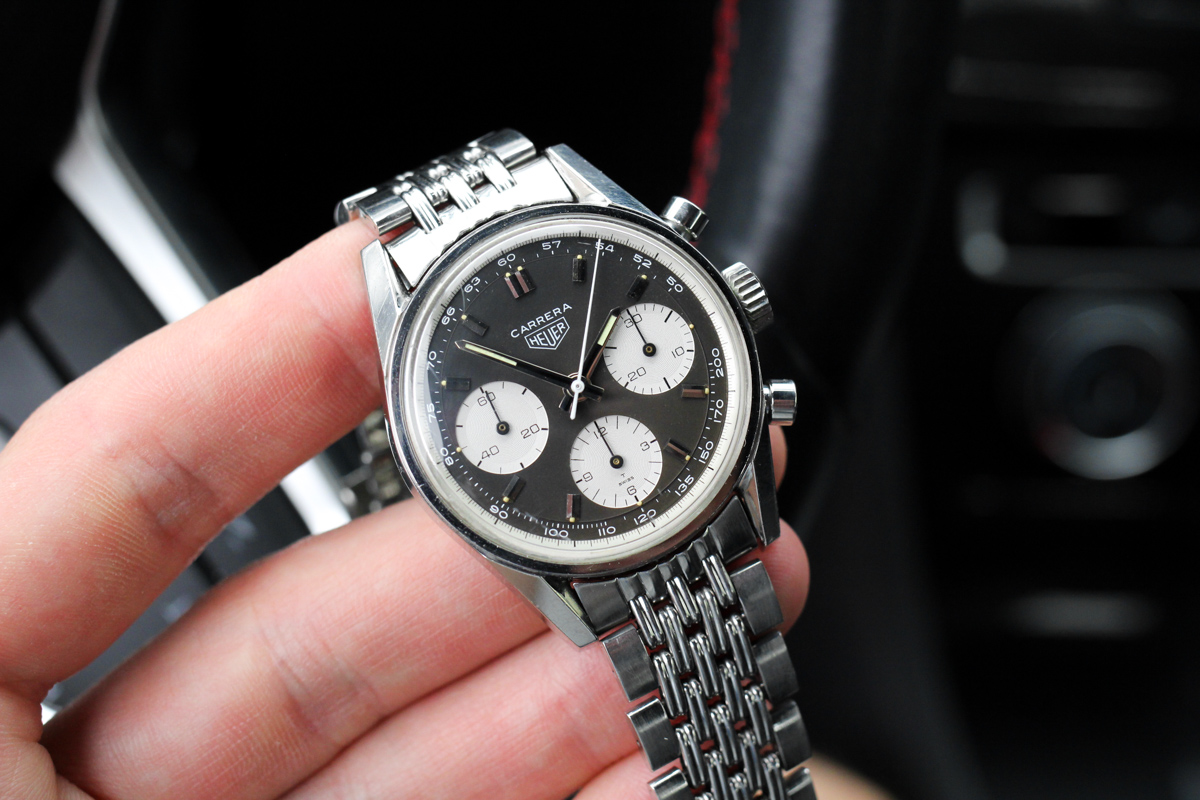
The Watch That Breaks the Rules
At first glance, this example appears to be a typical second execution 2447NST: the inverse panda design is the biggest giveaway, as first executions did not offer contrasting subdials, as well as the distinctive stepped dial with stubby hour markers and striped handset. But a closer look reveals something more interesting.
This dial carries first execution markings – a tachymeter scale and layout that belong to the earliest Carreras (scroll back up to compare to the 2447T with a red scale) – while the rest of the dial architecture unmistakably aligns with second execution production. Even the hour markers are the later style but lack the contrasting striping found on standard second execution examples. In plain English, this dial straddles two distinct periods of Carrera production, carrying key design elements from both executions.
Then there’s the serial: 920XX. For the brightest students in the class, you will recall that this fits squarely within the “overlap” between observed serials for first and second execution tachymeter dials. Transitional production quirks like this aren’t uncommon in Swiss watchmaking, but to-date, there has not been a single 2447 Carrera uncovered that combined elements from both periods. For a model as studied as the Carrera, finding a dial that is truly unique is extraordinary.

Searching For An Answer
There are few thrills that match a random text from a dealer friend that says “I just found something that you will want.” While home for the holidays in 2019, I received such a text from a friend with a few pictures of this 2447 Carrera and a backstory about its unearthing. It was immediately interesting to me for the slate gray color of the dial, which seemed unique compared to all of the other examples I had owned or seen, and incredible condition of the case and dial. I didn’t even clock the mismatched tachymeter scale and dial architecture right away, but there was something about the watch that immediately stuck out to my eye and felt wrong.
After a couple of minutes, it clicked in my head and I pulled out two Carreras from my watch box (a decided benefit of being a Carrera diehard), a first and second execution, to compare against the pictures. With the dials under a loupe and enlarged pictures of the 2447NST in question, I came to my conclusion: this was either the greatest fake ever produced, or a legitimate unicorn in the world of Carreras.

Vintage collecting often comes down to trusting your gut, and despite having no clear reference or evidence to fall back on, I told my friend that I wanted the watch. A week later, the watch landed in my hands and I became more confident that the dial was indeed genuine. Even more importantly, the serial number falling within the transition between first and second execution dials provided additional support that the watch was born this way, rather than pieced together.
Despite my conviction about its legitimacy, it always feels better to have support from people who are more knowledgeable. I am lucky enough to have two friends who are quite possibly the most learned minds on Vintage Heuer on the planet – Jeff Stein (legendary collector and the mind behind OnTheDash) and Nick Biebuyck (Heuer’s Heritage Director) – and I knew I had to reach out to them for additional support.
Interestingly, both Jeff and Nick confirmed that they had not come across a dial like this one previously. The next step was to leverage Nick’s position within Heuer to search for any evidence that the dial was produced, either in the archives or the company’s expansive collection of dials. To my (and Nick and Jeff’s) surprise, we struck out there as well. There were no records of this dial ever being produced by Heuer.
So that brings us to the final point – was it a legitimate dial produced for Heuer? Thankfully, we all reached the same conclusion after some back and forth. We agreed that the dial was a legitimate Singer dial that was produced for Heuer, and while we would never definitively know the watch’s origin, it appeared to be a strange but interesting addition to the 2447’s history.

Why It Matters
Okay, congrats if you’ve made it this far. To casual observers, this may seem like a minor footnote in Carrera history – a small printing anomaly or parts crossover that isn’t a very big deal. But to seasoned collectors and Heuer lovers, this find actually matters quite a bit. This isn’t the same as, for example, the simple addition of an underline or an extra “SWISS” at the bottom of the dial (sorry, Rolex collectors!), which are minute variations from other dials – it’s an entirely different visual experience.
There’s also the question of why it matters to me. Simply put, I love the way this transitional dial looks and believe that it draws from the best of both executions. I prefer the first execution’s tachymeter scale, finding it to be far less cramped and more useful to the wearer, and combining the Base 200 scale with inverse panda subdials and an interesting grayish hue creates a one of a kind watch. In my admittedly biased opinion, this unique example is one of the most attractive Carreras out there.
Ultimately, it’s the kind of watch that reminds collectors why they keep digging, comparing, and documenting: because every now and then, something surfaces that rewrites a small piece of the story.
Collector’s Notes
Reference: Heuer Carrera 2447NST
Movement: Valjoux 72
Serial Number: 920XX
Dial Details: Second execution dial with first execution tachymeter and markings
Known Examples: 1
References: OnTheDash.com; Heuer Carrera by Croswaite and Gavin


